
Ecology and Oceanography of
Harmful Algal Blooms
Ecology and Oceanography of Harmful Algal Blooms (ECOHAB) is a national, peer-reviewed, competitive research funding program that seeks to achieve a holistic, quantitative understanding of nuisance and toxin-producing HABs to inform the development of predictive models, forecasts, mitigation tools, and prevention strategies.
Program Details
ECOHAB was authorized by the Harmful Algal Bloom and Hypoxia Research and Control Act (HABHRCA, 33 U.S.C. §§ 4001 et seq.) in 1998 and reauthorized in 2004, 2014, and 2017.
Targeted ECOHAB studies address fundamental ecological and oceanographic questions related to understanding HAB events; these studies are conducted by individual investigators or small teams and are typically 2 to 3 years in duration. Regional-scale and comparative, cross-regional ECOHAB investigations are conducted by multi-disciplinary and multi-institutional project teams and are typically 3 to 5 years in duration.
Program Priorities
ECOHAB’s priority areas include:

The local and regional drivers that govern bloom initiation, maintenance, toxin production (where applicable), and termination from cellular-level processes to ecosystem-level interactions

The biosynthesis and mechanism of toxicity of known and emerging toxins (including those that are tumor-promoting or lead to long-term effects), including their persistence in dissolved and particulate form, and degradation in aquatic ecosystems

The uptake and depuration of toxins in commercial and subsistence seafoods and important prey species, including toxin biotransformation and fate

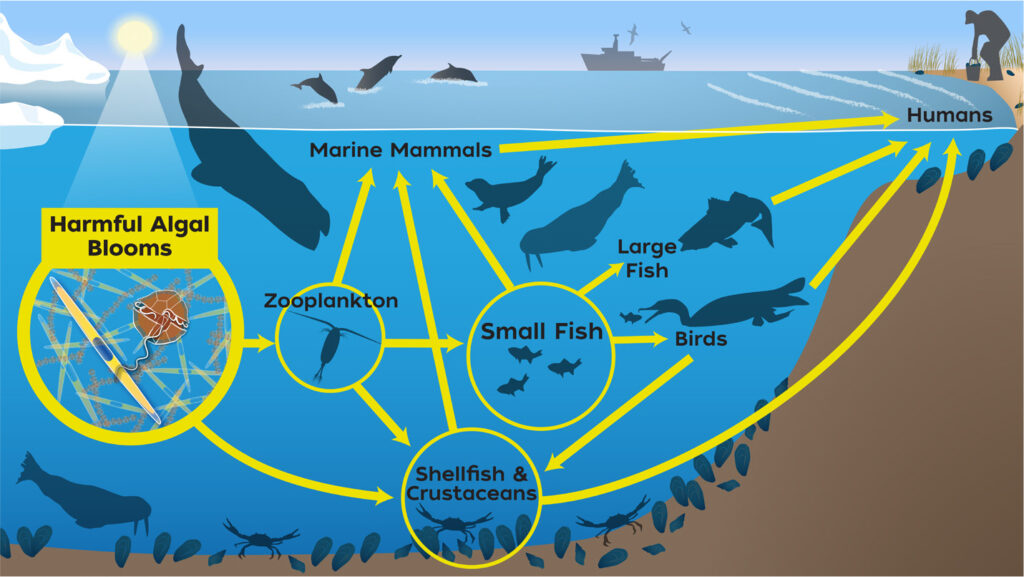
The trophic transfer of toxins in aquatic food webs, including the consequences of exposure of humans and animals to HABs via various routes, and cell and toxicity thresholds for HAB toxins and secondary metabolites

The presence of HAB toxins in subsistence resources and related risks to food safety and security

The effects of environmental or anthropogenic changes, such as eutrophication, ocean acidification, or climate change, on HABs and their impacts
Funding Announcement
Notice of Funding Opportunity (NOFO) announcements for ECOHAB and other national competitive HAB programs are available on the NCCOS Funding Opportunities page.
Check back for available funding.
The NCCOS Competitive Research Program is pleased to announce a Fiscal Year 2024 Notice of Funding Opportunity (NOFO) for the Ecology and Oceanography of Harmful Algal Blooms (ECOHAB) Program.
Key Dates
- October 5, 2023 – Informational webinar. (Slides, Recording, and FAQ)
- October 18, 2023 – REQUIRED Letters of Intent (LOI) due by 11:59 p.m. ET. Email LOIs to nccos.grant.awards@noaa.gov; responses will be provided to applicants in approximately 2 weeks.
- January 31, 2024 – Applications due by 11:59 p.m. ET. Submit full applications to Grants.gov.
Resources for Applicants
- Quick Reference Guide for NCCOS Competitive Research Program Applications
- Sample Application
- FY2024 ECOHAB NOFO informational webinar: Slides, Recording, and FAQ
- Ongoing: Office hours with ECOHAB Program Manager Maggie Broadwater (schedule here)
Are you interested in serving as a panel reviewer for the ECOHAB program? Reviewers are critical to ensure NOAA funds the best possible science. Sign up here.
Current Funded Projects
- Life and Death of Karenia brevis Blooms in the Eastern Gulf of America (2019)
- Oceanographic and Cellular Controls on Domoic Acid Production in the Central and Southern California Current System (2019)
- Multidisciplinary approach to a cross-regional problem: Dinophysis and DSP toxicity (2019)
- Trophic transfer and effects of HAB toxins in Alaskan marine food webs (2020)
- Coastal acidification and harmful dinoflagellate blooms: interactions and emerging implications for marine ecosystems and organisms (2022*)
- HAB dinoflagellate migrations across carbonate system gradients in an acidified ocean (2022*)
- Salish Sea HAB response to ocean acidification and concomitant stressors of increased sea surface temperature and nutrification (2022*)
- Synergistic impact of climate induced acidification, temperature, total alkalinity, and nutrients on cyanobacteria HABs in the Great Lakes (2022*)
- Evaluating the Effects of Nitrogen Form and Concentration on Toxin Phenotypes of Microcystis (2025)
- HAB Toxin Accumulation, Exposure Risks, and Impacts in Alaskan Artic Marine Subsistence Resources (2025)
- Persistence and Trophic Transfer of Harmful Algal Bloom Toxins in Gulf and Atlantic Estuaries (2025)
- Assessing How Nitrogen and Acidification Affect HABs in an Urban Estuary (2025)
- Cyanobacterial Blooms and Toxins in a High-Latitude Estuary: An Emerging Threat with Potential Impacts on Subsistence Resources (2025)
*2022 Funding Opportunity: Integrated Research on Ocean & Coastal Acidification and Harmful Algal Blooms, in partnership with NOAA’s Ocean Acidification Program.
Past Projects
View HAB event responses since 2015 that received funding support from the HABER Program; responses organized by funding recipient in each region and state.
- Responding to Harmful Algal Bloom – Sitka Tribe of Alaska ($12,950)
- Responding to Multispecies Mortality Event Occurring in Norton Sound Region ($15,000)
- Testing Tribal Shellfish for Toxin in Southwest Alaska ($48,507)
- Collecting Real-Time Harmful Algal Bloom Data in Alaska ($29,923)
- Communicating Harmful Algal Bloom Risk to Communities in the Bering Strait Region ($15,000)
- Investigating Unusual Marine Animal Mortalities and Possible Harmful Algal Bloom around Kachemak Bay ($5,000)
- Responding to Multispecies Mortality Event in St. George Island, Alaska ($5,344)
- Sampling Harmful Algal Bloom In Kachemak Bay ($19,800)
Ohio
Massachusetts
New York
- Investigating Diamondback Terrapin Die-Offs ($5,400)
- Responding to Ongoing Harmful Algal Blooms in Long Island ($19,000)
Virginia
Florida
- Assessing Martin County Threat of Blue-green Algal Toxin ($9,273)
- Monitoring Brown Tide in Indian River Lagoon ($7,096)
- Studying Airborne Health Risks from Cyanobacteria Blooms ($5,000)
- Investigating Unusual Fish Behavior in the Florida Keys ($25,000)
Puerto Rico
- Supporting Sargassum Response ($38,467)
Alabama
Florida
- Responding to Red Tide ($19,200)
- Examining Sea Turtle Mortalities and Dietary Exposure to Red Tide Toxins ($10,045)
- Testing Treatment for Birds Sickened by Red Tide ($8,250)
- Sampling Ongoing Red Tide to Determine Impacts ($28,000)
- Quantifying Toxin Accumulation in Seabirds and Prey Fish ($7,820)
Louisiana
- Responding to Cyanobacterial Blooms in Lake Pontchartrain Caused by Opening Bonnet Carre Spillway ($12,907)
Texas
California
- Responding to Southern California Harmful Algal Bloom Event ($14,250)
- Investigating Bioluminescent Red Tide Event Off Southern California Coast ($17,950)
- Responding to Harmful Algal Bloom in the San Francisco Bay ($15,420)
- Responding to Harmful Algal Bloom Following Marine Mammal Strandings in Southern California ($12,550)
- Responding to Marine Mammal Mortality Event Occurring in Southern California ($4,520)
Washington
Additional Resources
For more information
- Contact Maggie Broadwater, ECOHAB Manager
- ECOHAB Program One-Pager
For additional HAB Competitive Research Programs visit