 An official website of the United States government.
  Official websites use .gov
A .gov website belongs to an official government organization in the United States.
Official websites use .gov
A .gov website belongs to an official government organization in the United States. Secure .gov websites use HTTPS
A lock or https:// means you’ve safely connected to the .gov website. Share sensitive information only on official, secure websites.
Secure .gov websites use HTTPS
A lock or https:// means you’ve safely connected to the .gov website. Share sensitive information only on official, secure websites.
A team of scientists and explorers, including researchers from the NCCOS Deep Coral Ecology Laboratory in Charleston, South Carolina, completed its first season of fieldwork in the Gulf of Mexico, collecting samples of deep-sea coral species affected by the Deepwater Horizon oil spill in 2010. The team conducted two research expeditions between July and October of 2017, using remotely operated vehicles to sample deep-water corals at multiple locations, ranging from depths of 150 to 7,218 feet.
The team will use restriction-site associated DNA (RAD) sequencing techniques to reveal the population structure of the coral species sampled. RAD-tag sequencing—a new method, roughly 10 years in existence—has been used effectively in studies of phylogeography and population genomics. By understanding the distribution of coral species, the genetic connectivity of their populations, and the human impacts to these populations, the researchers can provide information needed to restore and manage deep-sea corals in the Gulf of Mexico.
The two-year project, funded by the NOAA RESTORE Science Program, is led by Dr. Santiago Herrera of Lehigh University, and includes researchers from NCCOS, the Georgia Institute of Technology, Harvey Mudd College, Temple University, and the Flower Garden Banks National Marine Sanctuary.
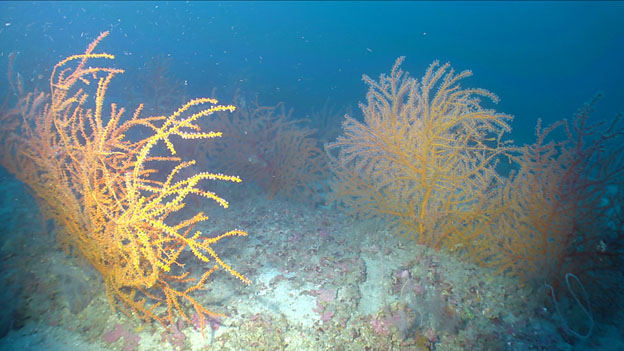
Deep-water sea fans (Swiftia exserta) at a depth of 210 feet on East Flower Garden Bank off the Texas coast. The species is known to have been negatively affected by the Deepwater Horizon oil spill. Credit: NOAA.