
NCCOS Hollings Marine Laboratory
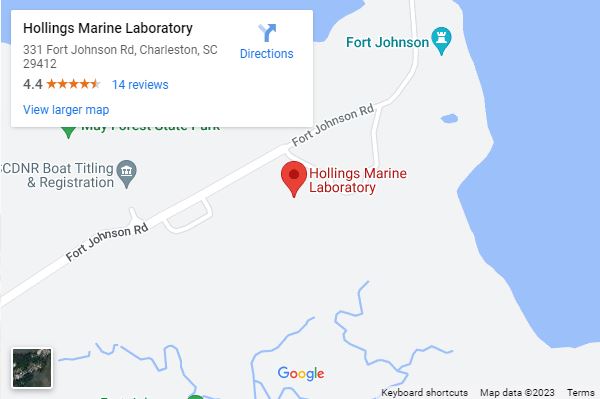
The Hollings Marine Laboratory is built on an approximately 8-acre site within the Fort Johnson campus of the South Carolina Marine Resources Center in Charleston, South Carolina. Dedicated on December 21, 2000, the 103,000 square foot laboratory promotes collaborative and interdisciplinary scientific research to sustain, protect, and restore coastal ecosystems. The facility boasts a collection of laboratories that provide applied science to keep America’s coastal communities and economies safe from contaminants, storm surge and flooding, and poorly planned offshore development. NCCOS scientists provide life-saving tools to detect toxic algae and contaminants, understand how toxins like polyfluoroalkyl substances (more commonly referred to as PFAS) and oil dispersants impact coastal animals, and monitor marine mammal health with an emphasis on understanding the implications to human health.
Areas of Focus
Hollings Marine Lab addresses NCCOS priorities of resilience, contaminants, marine spatial ecology, and harmful algal blooms through the following science areas.
Partnerships: Moving Forward Together
While NOAA manages and maintains the physical building, partnerships are a critical component of the science that takes place at Hollings Marine Lab. Nearly 130 scientists, including federal, state, and academic partners work collaboratively to tackle coastal ocean science issues that impact these ecosystems and affect coastal communities. These symbiotic partnerships are crucial for critical knowledge building and efficiently leveraging laboratory space, and expensive scientific instruments.
Partners include:
The National Institute of Standards and Technology (NIST) is a U.S. federal agency that conducts cutting-edge measurement science research to drive innovation, support economic growth, and enhance quality of life for all Americans. NIST provides support and resources to U.S. manufacturing and ensures our national security.
Several groups within NIST’s Chemical Sciences Division are a part of the HML community, including the Inorganic Metrology Group, Chemical Informatics Group, Biospecimen Science Group, and the Biochemical and Exposure Science Group. These teams oversee the NIST Biorepository–a cryogenic facility with more than 215,000 biospecimens–and operate an 800-megahertz Nuclear Magnetic Resonance Spectrometer to advance scientific research.
At HML, NIST scientists develop and certify standard reference materials, disseminate reference data, and enhance the harmonization of measurements to support technology innovation across sectors.
Established in 1970, the College of Charleston’s (CofC) Graduate Program in Marine Biology is anchored at the Grice Marine Lab on Fort Johnson campus, with additional research conducted at HML. This collaboration provides CofC marine scientists and graduate students with the opportunity to work alongside leading marine scientists and access state of the art facilities.
CofC researchers at HML explore a wide range of topics including proteomics, biogeochemical cycling, marine phytoplankton ecology, physiological biology, transciptomics, genetics, microbial ecology and biogeography, benthic biology, and more. Whether analyzing proteins in dolphin urine, examining the neurological effects of domoic acid on California sea lions, or investigating nutrient cycling in Antarctic phytoplankton communities, CofC scientists are advancing marine science to preserve our marine environment while training the next generation of marine scientists!
The South Carolina Department of Natural Resources (SCDNR) Marine Resources Division maintains a strong presence on the Fort Johnson Campus, with scientists working in both the Marine Resources Research Institute and HML. Their work at HML focuses on population genetics and mariculture.
The SCDNR Genetics team uses DNA analysis to study and better understand population dynamics, genetic health distributions, stocking contribution, host-pathogen interactions, and more. HML is home to a state-of-the-art mariculture system with twenty-four 400 gallon experimental tanks and two 4,000 gallon broodstock tanks. The SCDNR Mariculture team conducts reproduction and stock enhancement research with a focus on estuarine fish species. As part of applied fishery science efforts, they conduct feeding studies using hatchery fish to evaluate effects of alternative feed ingredients and nutritional impacts on fish health and growth.
Founded in 1824, the Medical University of South Carolina (MUSC) has a rich legacy of connecting environmental science to human health. At HML, MUSC researchers study the clinical potential of natural marine products.
One ongoing project involves a deep-water sponge discovered off the coast of Alaska that produces a compound called aleutianamine, which shows promise in combating pancreatic cancer. MUSC scientists are actively studying this sponge and its compounds in an effort to bring this research to clinical trials. Additional studies focus on therapeutic compounds derived from marine macroalgae (seaweed), with promising results for treating diabetes and liver disease. Some macroalgae species have demonstrated the ability to break down compounds that contribute to harmful glycation in the body, an encouraging step toward new treatment options.
Two NOAA Fisheries offices operate from HML: NOAA Fisheries Southeast Regional Office and NOAA Northwest Fisheries Science Center Marine Forensic Laboratory.
NOAA Fisheries Southeast Regional Office works with scientists and engineers from utility companies, universities, and government agencies to provide fish passage at hydroelectric dams managed under the Federal Power Act. This work entails conventional field studies as well as telemetry and eDNA studies to evaluate populations of sea-run migratory fish affected by dams. In collaboration with other HML scientists, this group examines effects of human activities on corals and coral reef ecosystems, including establishing turbidity and sedimentation thresholds that avoid impacts to corals during dredging, especially corals protected under the Endangered Species Act.
The NOAA Northwest Fisheries Science Center Marine Forensic Laboratory has a location on each coast: one in Seattle, WA and one at HML. The Marine Forensic Laboratory analyzes evidence collected during the investigation of civil and criminal violations of laws protecting both consumers and marine species. Scientists have analyzed evidence for more than 1,200 civil and criminal investigations involving violations of the Lacey Act, the Endangered Species Act, the Marine Mammal Protection Act, the Magnuson-Stevens Act, and the Seafood Import Monitoring Program, as well as violations that breach the Convention on International Trade in Endangered Species (CITES).
National Environmental Satellite, Data, and Information Service (NESDIS) helps strengthen the work of other NOAA offices at HML through the National Centers for Environmental Information (NCEI). NESDIS provides the satellite and in-situ observations essential for HML research, including ocean color, sea-surface temperature, chlorophyll, deep-sea coral and sponge occurrences, and other measurements that help scientists monitor coastal conditions and interpret changes over time.
Within NESDIS, NCEI supplies the long-term environmental data that give HML studies historical context, enabling trend analysis, baseline development, and model validation. NCEI also helps preserve and distribute data produced at the lab, ensuring it is well-documented and accessible to the public.
Together, NESDIS and NCEI deliver the environmental intelligence and data stewardship that allow HML scientists to understand ecosystem dynamics and support broader natural resource decision-making.
About Hollings Marine Lab
HML is a NOAA-owned facility operated by the National
Centers for Coastal Ocean Science as a fully collaborative
enterprise, governed by the five partner organizations through
a Joint Project Agreement. Scientists from all
partner institutions work side-by-side in the laboratory, taking
advantage of each other’s extensive experience and specialized expertise.
Featured Staff Videos
Day in the Life of a Hollings Marine Lab Scientist

Hollings Marine Lab Partner Updates
View quarterly updates, highlights, accomplishments, and publications from each partner residing at Hollings Marine Lab.
Featured Stories