
A new study shows that some coastal fish may be able to condition their offspring to tolerate seasonally acidifying environments, a result never shown before in wild fish populations.
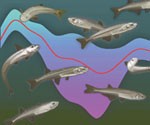
their offspring to naturally occurring, seasonal acidification
in their spawning habitat (artwork shape depicts the annual pattern of pH mean, minimum, and maximum). Artwork: H. Baumann and C. Murray.
Researchers funded by NCCOS and NOAA’s Ocean Acidification Program sampled a wild, spawning population of Atlantic silversides, then combined this information with carbon dioxide exposure experiments and associated coastal ecosystem monitoring data. The team found that young fish spawned early in April showed reduced survival and growth with higher carbon dioxide exposure (i.e., greater acidity), while fish spawned later in the season tolerated higher carbon dioxide.
By mid-May, offspring survival remained high at all carbon dioxide levels, which coincided with a rapid seasonal increase in carbon dioxide in the species’ near-shore spawning habitat. While further research is needed to account for a broader range of generational and environmental factors, these initial results suggest thatAtlantic silversides can condition their offspring to seasonally acidifying environments.
The rise in atmospheric carbon dioxide is making the oceans more acidic. Although many studies document the effects of ocean acidification on a particular marine plant or animal species, most of these studies are short term and exclude multiple generations. The capacity of marine organisms to adapt to rising carbon dioxide levels over several generations remains largely unknown.
This study was published in the journal Marine Ecology Progress Series .
For more information, contact Elizabeth.Turner@noaa.gov.