
Effects of Sea Level Rise (ESLR)
Event Response Program
The pursuit of more resilient coastal communities and ecosystems has led to international efforts to better quantify environmental resilience and realize flood protection solutions with diverse benefits. The resilience of coastal ecosystems to sea level rise and storms is often affected, positively and negatively, by short-term acute events. In addition, natural and nature based features (NNBF) have borne out of this effort and encompass an array of solutions that incorporate natural habitats, nature based landscape features, or more engineered designs that provide engineering functions relevant to flood risk management while offering additional environmental, social, and economic benefits.

This is a North Carolina Beach with protective dune showing heavy grass growth. NOAA (Dave Kidwell)
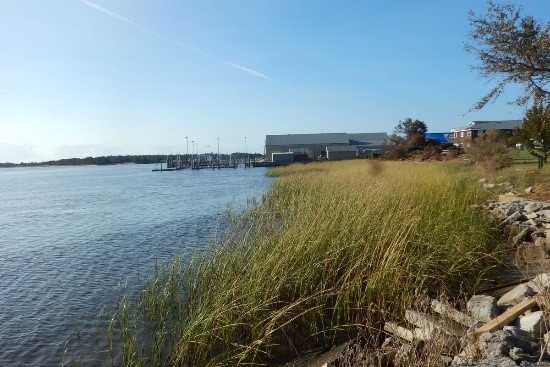
The living shoreline of cordgrass and oyster reef was built by NOAA to protect Pivers Island in Beaufort, North Carolina. (NOAA)

Oct. 14, 2016- The onshore pounding of waves and storm surge from Hurricane Matthew washed away parts of the protective dunes at Jacksonville Beach, Florida. (NOAA)

Heavy equipment moves sediment around restored areas of a barrier island. Large scale projects offer potential solutions, however we still need to understand how they perform during storm events. (NOAA)
A major decision gap surrounding how NNBFs should be used as an alternative to traditional engineering is due to the lack of understanding of how these features perform during storm events. The ESLR Event Response Program provides immediate assistance to individuals to gather data prior, during, and/or immediately after events that are difficult to plan as part of a scientific study. The program expects these findings will help federal, state, and local officials manage events and make sound decisions leading to safer coastal communities and healthier coastal environments. Modest funding is available to augment current or prior research to help offset costs of immediate mobilization of response and/or assessment efforts. Specific project activities of interest include pre- and/or post-event monitoring and/or modeling activities. These efforts must inform at least two of the following;
- assessments of long-term ecosystem vulnerability,
- habitat restoration or NNBF implementation planning,
- the ability of coastal ecosystems or nature-based infrastructure to reduce and/or mitigate coastal inundation impacts on ecosystems, natural resources, or communities.
Due to limited funding, prioritized scenarios include:
- Quantifying impacts of inundation on natural habitats and natural based features and the feedback those habitats had on inundation and economic damage to the region.
- Reassessment of community perception of vulnerability after a storm event that has impacted coastal infrastructure.
Prioritized events include but are not limited to:
- Weather-related events, such as nor’easters, tropical storms, nuisance flooding, abnormal wave conditions, or prolonged rain events;
- Anthropogenic associated events, including episodic events (e.g., flood driven opening of a water diversion) and singular events (e.g., unplanned levee breach). Anthropogenic activities with an extended planning cycle will not be considered.
How to Apply for NCCOS ESLR Rapid Assessment Event Response Funding
- Scientists or management officials can initiate requests for assistance by contacting the program managers listed below (please cc all).
- Program managers may consult NOAA colleagues and/or other federal or state agencies to determine a recommended course of action.
- If the potential for support is determined, the applicant will be asked to submit a brief, formal request to the designated program manager (<5 pages). A formal request should include the following:
- Description of the events/impacts and need for urgency
- Intended assessment plan
- CV for the Principal Investigator
- Listing of managers and researchers involved
- Explanation of assistance/support needed
- Brief budget and budget justification if funds are requested
- Description of existing support for related research
- Requirements also include reporting to the designated Program manager: important preliminary results; completing a brief, written final report; acknowledging the Event Response Program in publications that result wholly or in part from NCCOS funding; and notifying the program about related publications.
Contact Information
Contact NCCOS ESLR Event Response Co-managers for more information or to inquire about support:
David Kidwell, Competitive Research Program Director
Phone: (240) 533-0286
Email: David.Kidwell@noaa.gov
Trevor Meckley, ESLR Program Manager
Phone: (240) 533-0293
Email: Trevor.Meckley@noaa.gov
Current Projects
- Post–Hurricane Dorian Data Collection to Improve Understanding of Beach, Dune Recovery Following Storms
- Evaluating the Resilience of North Carolina Natural and Living Shorelines following Hurricane Dorian
- Evaluating Wave Impact Reduction and Shoreline Protection Provided by “Oyster Reef Living Shoreline Projects” During Storm Events
Examples of the types of monitoring for projects that would likely fit this opportunity (this is not an inclusive list):
Monitoring the sediment deposition or loss associated with an event to inform questions regarding: does a pulse of sediment from an event impact coastal processes that build dunes, marshes or mud flats?
Example Event
Monitoring the integrity of a feature and/or the flooding tangential to a feature associated with an event to answer questions on how did an NNBF perform during an event and what was the integrity of the features?
Example Event
Survey of residents, policy makers, and/or natural resource managers using an existing MOB approved survey to evaluate changes in perception following an event on individual’s readiness to adopt possible coastal resilience solutions, on the local perception of risk, or willingness to evacuate.