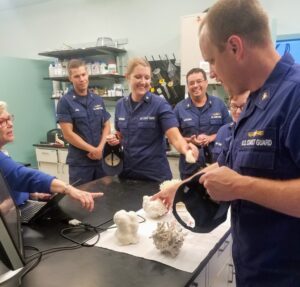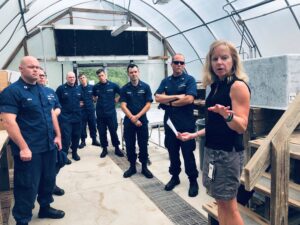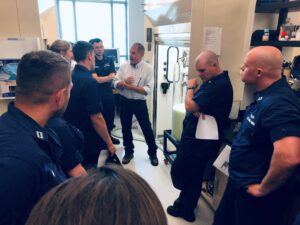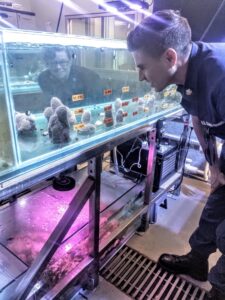
Earlier this month, NCCOS’s Charleston, South Carolina, laboratories hosted the Prevention and Response Departments from the U.S. Coast Guard (USCG) Sector Charleston. USCG staff toured the Charleston Lab and the Hollings Marine Lab, both operated by NCCOS.
The USCG group visited the shallow-water coral lab, the tidal estuarine simulation units (mesocosm), and challenge laboratories where NOAA scientists study how oil, chemicals, other contaminants affect marine and coastal environments. The USCG visitors also viewed a demonstration on emerging ozone nano-bubble technologies used to address ballast water issues, such as preventing releases of invasive species and the spread of disease.
USCG staff had the opportunity to meet NCCOS scientists and ask questions about their work, as well as exchange ideas on data sharing and ways to further support prevention and response activities. Specific experiments conducted in these labs provide information to federal, state, and local resource managers as they prepare for and respond to marine and coastal pollution events. The USCG group also learned about the challenges the NCCOS scientists experienced during and after the Deepwater Horizon oil spill event in 2010, as well as how NOAA scientists provide information to NOAA’s Office of Response and Restoration and Regional Scientific Support Coordinators.