
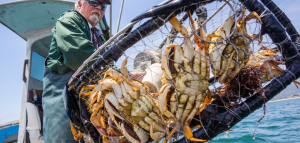
A NOAA-supported study projects that Dungeness crab and some commercial finfish species living on the sea floor may decline in future years due to increased ocean acidification in the California Current. These estimates were based on computer models forecasting changes in the California Current ocean ecosystem, which includes an expected rise in summer ocean acidification of 50 percent. Other marine organisms, including zooplankton, seabirds, marine mammals, and fish that live in the water column, are expected to be less affected.
Ocean acidification occurs when oceans partially absorb the increasing carbon dioxide in the atmosphere, resulting in a series of chemical reactions that decrease the pH of the seawater, making it more acidic. This process is exacerbated in the California Current during summer, when coastal upwelling brings cold, deep, nutrient-rich waters up onto the continental shelf that already have higher acidity and low oxygen concentrations.
Project scientists used global projections of CO2over the next fifty years, chemical and physical ocean data, and the ecology of 75 different species to project the future relative abundance of each, along with potential economic impacts. Ocean acidification is expected to directly affect certain food source species (shrimps, benthic grazers, benthic detritivores, bivalves) within the marine food web that are eaten by some commercially valuable species, including Dungeness crab, rockfish and sole.
The model provides information on species relevant to particular management focus areas (e.g., nearshore state-managed fisheries, or the groundfish management team with the Pacific Council). This could help prioritize management efforts with regards to ocean acidification by highlighting direct impacts to commercial species and the supporting role that shellfish and other species play in the food web.
For more information, check out the project page.
See also, ‘Study predicts decline in Dungeness crab from ocean acidification,’ Seattle Times, 15 January 2017.