
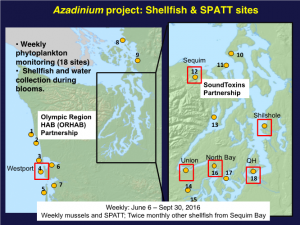
In early June 2016, NOAA and Washington State partners begin a four-month long effort to monitor shellfish and water every week at six locations around Puget Sound and on the Pacific coast. The team plans to measure concentrations of marine algae and their associated lipophilic (fat soluble) toxins, which can accumulate in shellfish and cause human illnesses when consumed.
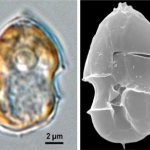
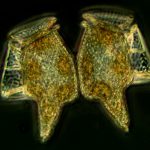
Lipophilic shellfish toxins comprise an extensive suite of compounds, including those associated with the human illnesses known as diarrhetic shellfish poisoning (DSP) and azaspiracid shellfish poisoning (AZP). Though research has documented several algal species associated with DSP in Washington waters, distribution and toxicity data is limited. While little is known about the distribution of algal species that produce AZP toxins in the U.S., they have been found in Puget Sound water and shellfish.
The research team will map the distribution of toxic algae that produce DSP and AZP toxins and establish and validate a tiered HAB early warning system using capabilities of the SoundToxins and ORHAB programs. Ultimately, the research will establish globally accepted protocols for quantifying a suite of lipophilic toxins to enhance state agency biotoxin monitoring programs.
The team is led by the NOAA Northwest Fisheries Science Center and includes the Washington Department of Health, University of Washington, Washington Sea Grant, NCCOS, Jamestown S’Klallam Tribe, the U.S. Food and Drug Administration, Molecular Resources, LLC, and the Alfred Wegener Institute, Germany. This is an NCCOS Monitoring and Event Response for Harmful Algal Bloom (MERHAB) -supported project.