The U.S. Government is closed. This site will not be updated; however NOAA websites and social media channels necessary to protect lives and property will be maintained. To learn more, visit www.commerce.gov. For the latest forecast and critical weather information, visit www.weather.gov

The U.S. government is closed. This site will not be updated; however, NOAA websites and social media channels necessary to protect lives and property will be maintained. To learn more, visit commerce.gov

For the latest forecasts and critical weather information, visit weather.gov.

HARMFUL ALGAL BLOOM FORECASTS

Gulf of Maine Alexandrium catenella Predictive Models

Annual Alexandrium catenella blooms in the Gulf of Maine produce potent neurotoxins that accumulate in shellfish and cause Paralytic Shellfish Poisoning (PSP) in human consumers. The following models have been developed to better predict and monitor these blooms and shellfish toxicity with the goal to minimize impacts to public health and coastal economies. See more information about our bloom monitoring imagery. 

Map of Gulf of Maine shows wind stress and model simulated surface A. catenella cell concentration. cell concentration appears on the left side of map between Cape Cod and Canada.

Gulf of Maine A. catenella Nowcast/Forecast Simulation

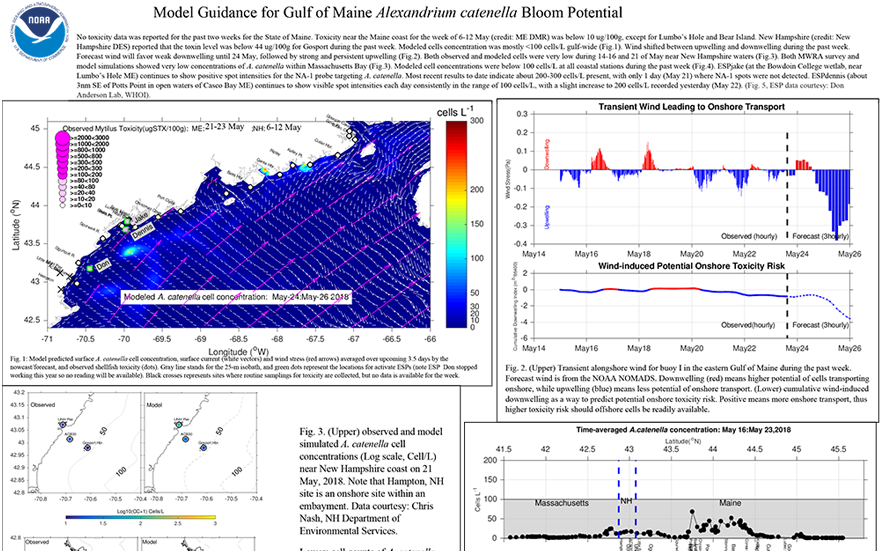
The experimental Gulf of Maine harmful algal bloom (the ‘red tide’) model provides real-time prediction of toxic Alexandrium catenella cells. Models include an animation showing surface wind fields and real-time bloom conditions.

Poster titled Model Guidance for Gulf of Maine Alexandrium catenella Bloom Potential. Includes map of Gulf of Maine with modeled potential. Bar graph shows transient wind leading to onshore transport from May 16 to 26. Line graph shows wind-induced potential onshore toxicity risk.

Gulf of Maine A. catenella Dashboard

Weekly updated, real-time dashboard for the Alexandrium catenella. When available, the dashboard contains forecast of wind, modeled cell concentration, estimated cell concentration estimated from real-time ESPs, and observed shellfish toxicity.