
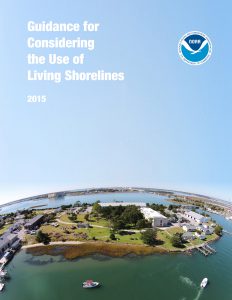
NOAA released Guidance for Considering the Use of Living Shorelines today. This publication was developed in an agency-wide effort to clarify NOAA’s encouragement for the use of living shorelines as a shoreline stabilization technique along sheltered coasts.
Living shorelines can preserve and improve habitats and their ecosystem services at the land-water interface. Although erosion is a natural coastal process, coastal communities face constant challenges from shoreline erosion that threaten valuable resources along the nation’s coastline. Living shorelines are gaining attention around the country as an alternative to traditional shoreline stabilization techniques like seawalls and bulkheads, which create a barrier between land and water.
Important components of the guidance include what to consider when selecting appropriate techniques (e.g., vegetation, edging, sills, vegetated breakwaters) to balance shoreline stabilization and coastal and marine resource conservation, and how to navigate NOAA’s potential regulatory (consultation and permitting) and programmatic roles in living shorelines project planning.
For more information, contact Carolyn.Currin@noaa.gov.