
The U.S. Government is closed. This site will not be updated; however NOAA websites and social media channels necessary to protect lives and property will be maintained. To learn more, visit www.commerce.gov. For the latest forecast and critical weather information, visit www.weather.gov

The U.S. government is closed. This site will not be updated; however, NOAA websites and social media channels necessary to protect lives and property will be maintained. To learn more, visit commerce.gov

For the latest forecasts and critical weather information, visit weather.gov.

NCCOS Supports Research Expedition in Gray’s Reef National Marine Sanctuary

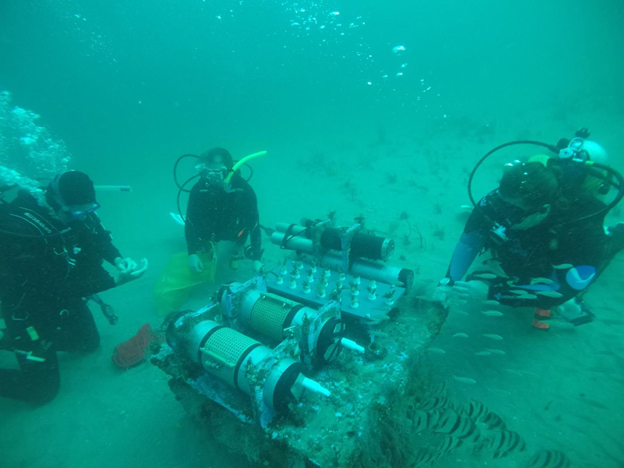
Scientists place coral on plates adjacent to carbon dioxide sensors to study ocean acidification in Gray's Reef National Marine Sanctuary, 2018.
Scientists place coral on plates adjacent to carbon dioxide sensors to study ocean acidification in Gray’s Reef National Marine Sanctuary, 2018. Credit: NOAA.

Earlier this month, NCCOS staff provided diving and science support for the 2018 research expedition in Gray’s Reef National Marine Sanctuary, located 19 miles off Sapelo Island, Georgia. Aboard NOAA Ship Nancy Foster, the NOAA team and scientists from Georgia Southern University completed work for multiple projects in the sanctuary’s scientific research area, which encompasses about eight square miles in the southern part of the sanctuary.

The researchers explored predator prey interactions, fish abundance and distribution, seafloor monitoring, algae diversity, and microbial communities in the sanctuary’s coral reefs. NCCOS staff assisted in the deployment and recovery of ocean acidification sensors, coral growth analyses, and placement of coral larvae collecting equipment.