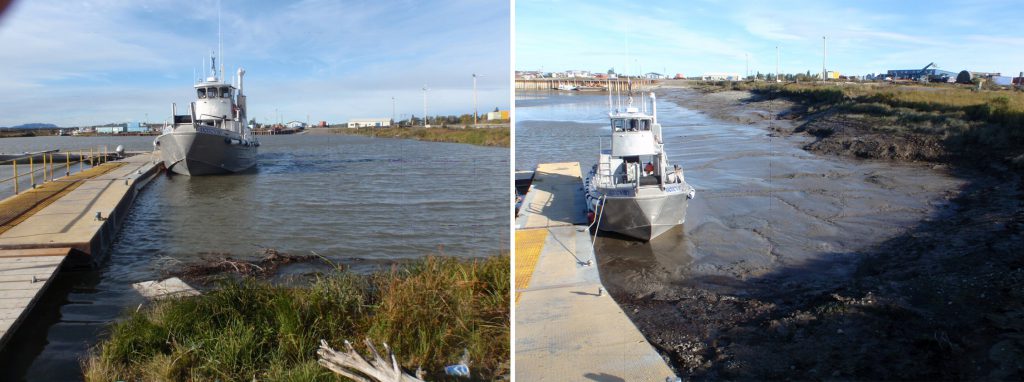
NCCOS and its partners have published an environmental assessment of Nushagak and Kvichak Bays, two of the most important salmon fishing grounds in Bristol Bay, Alaska.
Bristol Bay supports the largest commercial sockeye salmon fishery in the world, as well as strong runs of other salmon species. The bay is also an important destination for millions of birds migrating to the Arctic. State fisheries and water quality managers need habitat condition data to administer Bristol Bay’s resources, and information in this region is sparse.
The research team collected sediment samples for infauna, sediment chemistry, and toxicity bioassays, and collected fish to conduct body burden analyses of chemical contaminants. The researchers found the fish they tested to be generally healthy and uncontaminated. The team also found that persistent organic pollutant concentrations were low relative to National Oceanic and Atmospheric Administration (NOAA) sediment quality guidelines (SQG). All metal/metalloid concentrations were below NOAA SQGs, except for arsenic, which was uniformly above the threshold SQG.
Benthic communities were sparse at most locations due to harsh physical oceanographic conditions (20+ ft tidal range). Additionally, significant chemical toxicity was virtually absent, except for selected locations with high pore-water ammonia levels associated with fish processing plant waste streams.
NOAA led the project in collaboration with the U.S. National Park Service and The University of Alaska Fairbanks, and coordinated with the Alaska Department of Fish and Game and the Alaska Department of Environmental Conservation.
For more information, contact Ian.Hartwell@noaa.gov.