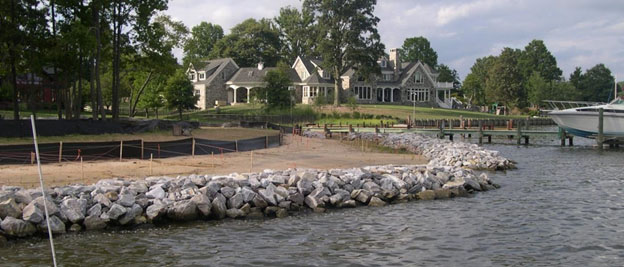
A new study funded by NCCOS shows that shoreline hardening—adding structures like seawalls and riprap in an effort to protect coastal land and property from the sea—degrades the habitat of submerged aquatic vegetation (SAV). Underwater grasses play a critical role in coastal estuaries, adding oxygen to the water, improving water clarity, stabilizing sediment, and providing shelter for juvenile members of economically important fisheries.
The researchers found that SAV in mid-Atlantic coastal bays was less prevalent, patchier, and supported fewer species in the presence of riprap—rock, broken concrete, or other rubble placed on shorelines to prevent coastal erosion. The team also found that SAV adjacent to natural shorelines showed more re-growth after storms than SAV adjacent to hardened shorelines. Project results will inform coastal zone management decisions about shoreline hardening, which is being driven by growing coastal populations and rising sea levels.
The study’s lead author (J. Brooke Landry, Maryland Department of Natural Resources) will host a NOAA Science Seminar on this research on November 2, 2017.