
The U.S. Government is closed. This site will not be updated; however NOAA websites and social media channels necessary to protect lives and property will be maintained. To learn more, visit www.commerce.gov. For the latest forecast and critical weather information, visit www.weather.gov

The U.S. government is closed. This site will not be updated; however, NOAA websites and social media channels necessary to protect lives and property will be maintained. To learn more, visit commerce.gov

For the latest forecasts and critical weather information, visit weather.gov.

Evidence of Climate-related Algal Community Shifts off North Carolina

At least seven species of marine algae previously restricted to more tropical waters have expanded their range northward to the temperate reefs off North Carolina. Reports of seven other new algae species are under investigation to determine if they also represent a tropical shift in North Carolina’s algal flora.
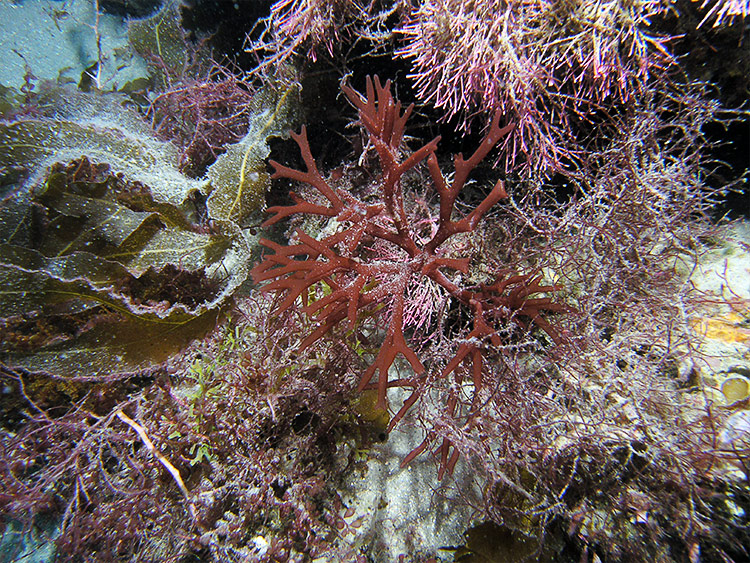
Shown are some of the rich marine algal diversity found on North Carolina temperate reefs. Dictyopteris hoytii; Botryocladia occidentalis; Dictyota ciliolata; Sebdenia flabellata; Solieria filiformis; Amphiroa beauvoisii
North Carolina’s temperate reefs have a rich diversity of marine algae. Shown here: Dictyopteris hoytii, Botryocladia occidentalis, Sebdenia flabellata, Solieria filiformis, and Amphiroa beauvoisii.

Researchers from the National Centers for Coastal Ocean Science and the University of North Carolina -Wilmington made these discoveries, as well as three species new to science, during an ecological characterization of the marine communities on North Carolina’s rocky reefs.
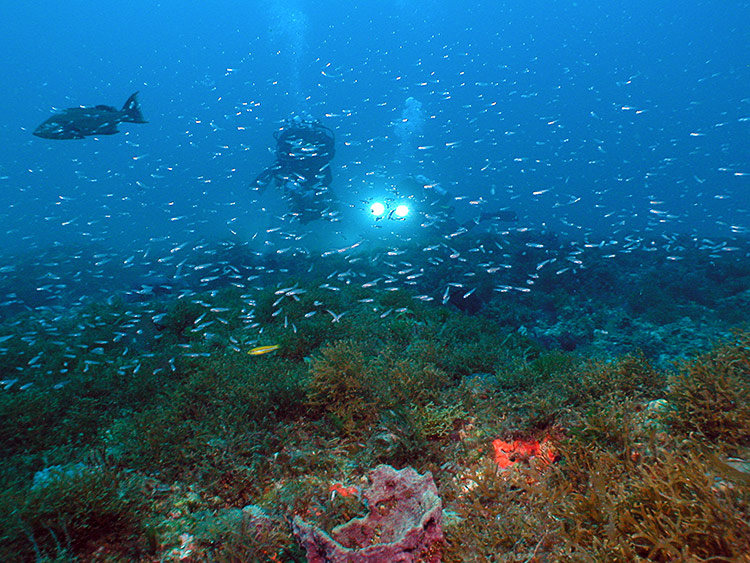
North Carolina has the richest marine algal flora along the Mid-Atlantic coast due to environmental variation and the variety of habitat types.

These reefs lie within a temperate-tropical transition zone. Globally, these reefs are becoming more tropical, making them important regions for detecting the effects of climate change. Algal distributions on these reefs are largely influenced by winter bottom water temperature and depth, and, as a result, will be critical in developing a better, more predictive, understanding of climate-associated responses in marine communities. This work included the most spatially comprehensive marine algal collections since the 1970s.

For more information, contact Paula.Whitfield@noaa.gov.