The U.S. Government is closed. This site will not be updated; however NOAA websites and social media channels necessary to protect lives and property will be maintained. To learn more, visit www.commerce.gov. For the latest forecast and critical weather information, visit www.weather.gov

The U.S. government is closed. This site will not be updated; however, NOAA websites and social media channels necessary to protect lives and property will be maintained. To learn more, visit commerce.gov

For the latest forecasts and critical weather information, visit weather.gov.

HAB Prevention and Control

Effective HAB prevention and control must consider the HAB species, their toxicity, the causes of the bloom, how the species interact with their environment, as well as the resulting environmental and socio-economic impacts. NCCOS research scientists and external grant-supported researchers are engaging with key partners and stakeholders to develop, test, and transition novel technologies at various scales.

What We're Doing

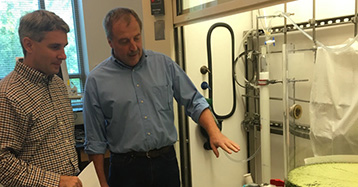
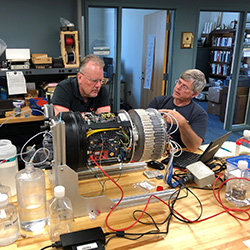
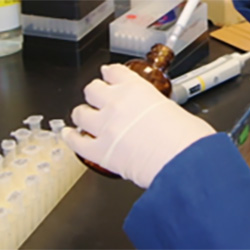
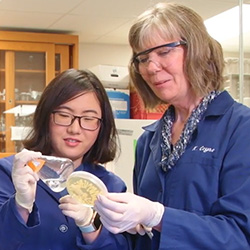
Two men in a laboratory.

Control
Control of harmful algal blooms requires developing technologies that can stop, disrupt, or restrict the life cycles of algal cells; remove cells from the water column so they settle to the bottom; or physically collect and remove algae. Development of strategies to date has been challenging. Our science has focused primarily on the use of biological and physical technologies to control HABs, in particular the use of nanobubbles, algicides and flocculants. We have recently initiated a national level control technology incubator to accelerate the development and quick assessment of control strategies.

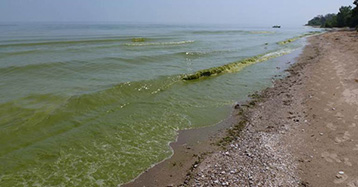
Small green waves lap on a beach

Prevention
Not all harmful algal blooms can be prevented, but some may with better management of human activities that lead to reduction of excess nutrients and improved habitat conditions. NCCOS has capabilities to help develop technologies that can help monitor and remove nutrients in ecosystems in order to restore habitats. Although NCCOS does not have authority to support activities that directly manage nutrients or restore habitats, our science seeks to understand the connection of blooms to human activities and how management strategies will affect the amount of nutrients in the ecosystem.

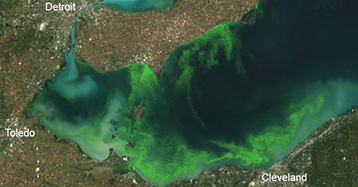
Satellite image of Lake Erie with green, swirling water along coastal areas to indicate harmful algal bloom.

Mitigation
Similar to impacts, the type and level of mitigation efforts are also dependent on which species caused the bloom, where it occurred, its duration, and how big it spread. Mitigation measures vary from public communication and education campaigns to application of specialized water treatment methods. Our scientists work to develop mitigation strategies across the many types, particularly detection and forecasting technologies for early warning and drinking water treatment to eliminate toxins.

Our Approach

Through a variety of methods, our researchers work with partners to identify HAB causes, develop effective control strategies, and transfer technologies for mitigation strategies.

HAB Prevention and Control

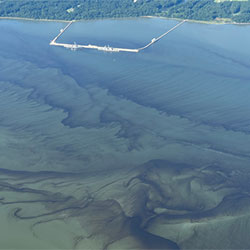
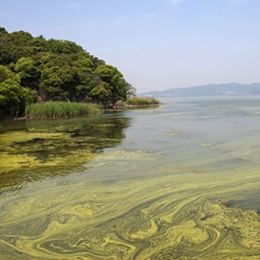
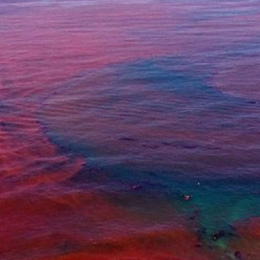
Aerial view of a body of water containing dark, swirly water
HAB Causes
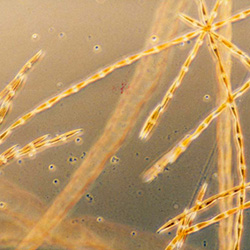
microscopic view of Pseudo-nitzchia
Biological Control
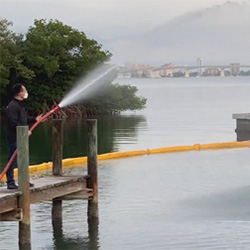
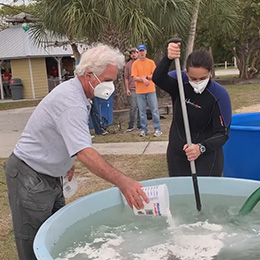
man on a dock sprays a liquid into the water. A yellow boom surrounds the dock.
Physical Control

Partnerships

While our research, scientists, and funding programs help develop technologies to prevent, control, and mitigate HABs, no entity alone can tackle the issue. As such, we partner with scientists from other NOAA offices, federal agencies, state management agencies, academia, and the private sector. To ensure that our activities are responsive to societal needs, we work with the relevant stakeholder and end user groups so that our research results are both actionable and timely, bringing effective solutions to this national level problem. Visit the Harmful Algal Bloom and Hypoxia Research and Control Act page to learn more about the Interagency Working Group that helps tackle the issue.