
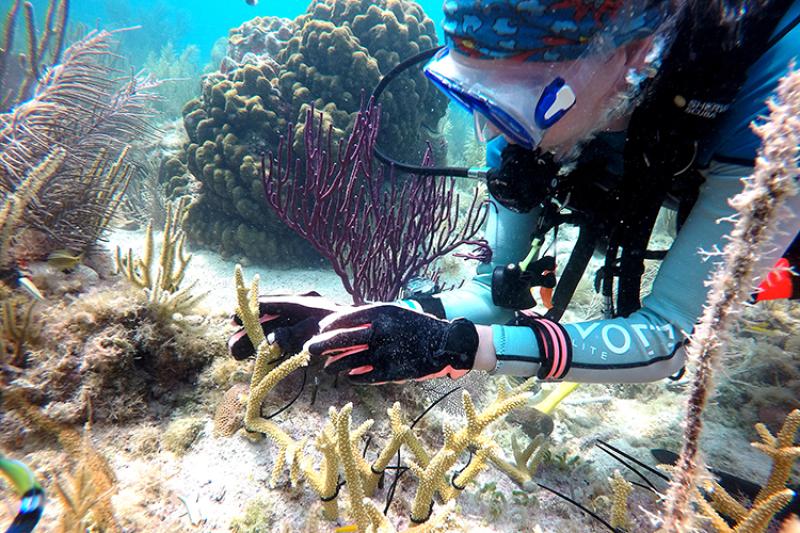
As coral reef restoration efforts increase in number and scale around the globe, there is also a growing need to measure their success using uniform, consistent metrics. NCCOS, the Florida Fish and Wildlife Conservation Commission, and their partners developed a tool that allows coral reef restoration managers to evaluate the robustness of each project and identify successful metrics and changes to restoration strategies that can improve performance and aid recovery.
The tool provides a simple, stop-light system that classifies the performance of a wide range of project components, including: transplant growth and survival, coral reproduction, recruitment of reef organisms to a restored site (e.g., corals, fish, invertebrates), increase in sustainability of reef fisheries, improvement to overall reef habitat (e.g., shelter, shoreline protection), success and challenges in restoration performance, and adaptability of techniques. Guidance and rationale on the scoring procedure are provided for each metric based on published research and expert opinion.
For more information, visit the research team’s project page.