
NCCOS scientists participated in a workshop last month in Annapolis, Maryland, to evaluate the relationship betweenwater quality and the restored oyster reef in Harris Creek, nearTilghman Island in Chesapeake Bay.
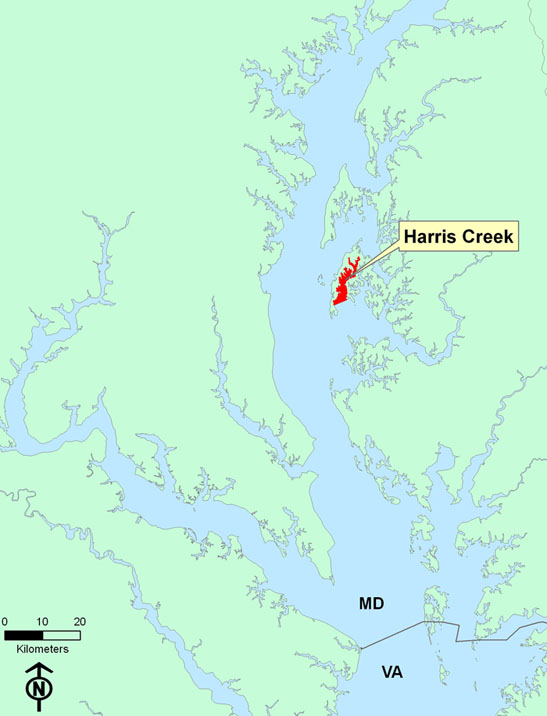
Harris Creek was the first tributary selected for restoration under the multi-agency Chesapeake Bay Watershed Agreement, which aims to restore oysters in 10 bay tributaries by 2025.At 350 acres, the Harris Creek oyster reef, from which oyster harvest is prohibited, is bigger than the National Mall and has been seeded with more than two billion oysters since 2011.
The workshop was held to coordinate the effortsof the Harris Creek Water Column Habitat Pilot Project’s Working and Advisory Groups to understand the dynamics of the creek’s water column habitat and how it affects and is affected by existing oyster reef restoration. The ultimate goals of the project are to evaluate the restoration and learn lessons that can guide oyster restoration at other locations.
As filter feeders, oysters can help improve water quality by consuming phytoplankton and excess nutrients in the water column. Oyster reefs provide habitat for economically important fisheries.Blue crab and striped bass are just two of the species in Chesapeake Bay that spend their juvenile phase on oyster beds, where nooks and crevices offer shelter from predators.
For more information, contact Suzanne.Bricker@noaa.gov or Shawn.Mclaughlin@noaa.gov.