
The U.S. Government is closed. This site will not be updated; however NOAA websites and social media channels necessary to protect lives and property will be maintained. To learn more, visit www.commerce.gov. For the latest forecast and critical weather information, visit www.weather.gov

The U.S. government is closed. This site will not be updated; however, NOAA websites and social media channels necessary to protect lives and property will be maintained. To learn more, visit commerce.gov

For the latest forecasts and critical weather information, visit weather.gov.

Cooperative Oxford Laboratory Hosts Geosciences Students

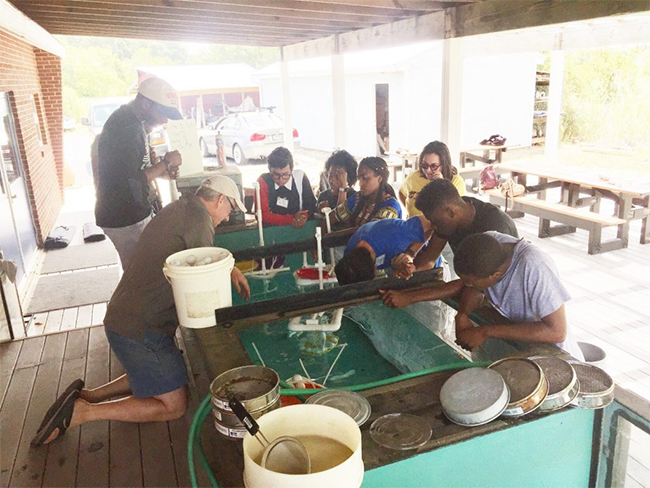
UMES Geosciences Bridge Program students at Cooperative Oxford Lab competing in building the least expensive buoy that will hold the most payload.
UMES Geosciences Bridge Program students at the Cooperative Oxford Laboratory competing in building the least expensive buoy that will hold the most payload. Credit: NOAA

The NCCOS Cooperative Oxford Laboratory in Oxford, Maryland, hosted students enrolled in the summer-long Geosciences Bridge Program, funded by the National Science Foundation and the NOAA Living Marine Resources Cooperative Science Center at the University of Maryland Eastern Shore (UMES).

The program introduces students entering college in the fall to ocean sciences, atmospheric sciences, remote sensing, and geographic information systems (GIS). Activities provided by NCCOS staff included a competition to build the least expensive, highest payload buoy; observing oyster larvae under blue light to observe growth markers; seeing mapping techniques to identify benthic habitats; and applying social science and GIS to decide where to place a marine sanctuary.