 An official website of the United States government.
  Official websites use .gov
A .gov website belongs to an official government organization in the United States.
Official websites use .gov
A .gov website belongs to an official government organization in the United States. Secure .gov websites use HTTPS
A lock or https:// means you’ve safely connected to the .gov website. Share sensitive information only on official, secure websites.
Secure .gov websites use HTTPS
A lock or https:// means you’ve safely connected to the .gov website. Share sensitive information only on official, secure websites.Harmful Algal Blooms
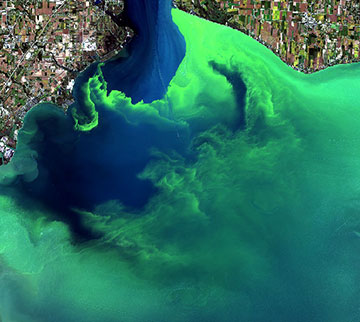
Harmful algal blooms (HABs) occur when algae—simple photosynthetic organisms that live in the sea and freshwater—grow out of control while producing toxic or harmful effects on people, fish, shellfish, marine mammals, and birds.
NCCOS research advances understanding of what causes and sustains HABs and their toxins, and uses that understanding to develop information and tools, predictive models, forecasts, and prevention strategies. Projects focus on how toxins are transferred across and up the food chain, including biosynthesis and metabolism of toxins, and assess the impacts of toxins on higher trophic levels. Our research informs management of coastal resources to reduce HAB development, impacts, and future threats.
NCCOS HAB Research and Operations
HAB Research At Our Laboratories
NCCOS oceanographers and chemists conduct research and develop innovative products that empower communities to take action on HAB events. Short-term forecasts pinpoint the location, size, and trajectory of current blooms. Long-term seasonal forecasts predict the severity of HABs for the bloom season. Citizen monitoring networks inform managers of the onset of toxic bloom events. Toxin sensors are designed and fabricated for hand-held and autonomous vehicles. Analytical methods and reference materials ensure measurements are accurate, and nanobubble ozone technology eliminates active blooms and the nutrients that can fuel them.
External Funding
The NCCOS Competitive Research Program funds research on HAB prevention, forecasting, ecosystem and socioeconomic impacts, detection, monitoring, control, and mitigation. Our goal is to provide new tools to federal, state, local, and tribal managers and industry partners. Forecasts predict bloom size and movement, providing early warning to managers. New methods of detecting HAB cells and toxins are improving monitoring capacity. Field tests of bloom control are ongoing. Together, these efforts are making drinking water and shellfish safer and minimizing impacts to tourism, aquaculture, and wildlife.
Harmful Algal Bloom and Hypoxia Research and Control Act
In 1998, Congress recognized the severity of these threats and authorized the Harmful Algal Bloom and Hypoxia Research and Control Act. The Harmful Algal Bloom and Hypoxia Research and Control Amendments Act of 2004 and 2014 reaffirmed and expanded the mandate for NOAA to advance the scientific understanding and ability to detect, monitor, assess, and predict HAB and hypoxia events.
The Economic Impact of HABs
Harmful algal blooms (HABs) occur when algae—simple plants that live in the sea and freshwater—grow out of control and sometimes produce toxins harmful to people and animals. Only a small number of species have the capacity to form harmful blooms, but when they do, the effects can be severe for coastal resources, local economies, and public health. HABs occur in every state, and new HABs have emerged in recent years, adding new threats to regions already impacted. NCCOS conducts and funds research that helps communities protect the public and combat blooms in cost-effective ways, and we are breaking new ground in the science of stopping blooms before they occur.
2014 Great Lakes Cyanobacteria Bloom
In 2014, officials in Toledo, Ohio, issued a two-day ban on drinking or cooking with tap water for more than 400,000 residents due to high levels of algal toxins resulting from a massive bloom in western Lake Erie. The bloom also affected fishing, tourism, and property values. The total impact of ecosystem service interruptions due to the 2014 HAB event was estimated at $65 million.
2015 West Coast HAB
In 2015, the largest HAB on the West Coast in at least 15 years stretched from central California to British Columbia and the Alaska Peninsula. Record-setting concentrations of domoic acid produced by the HAB event in California, Oregon, and Washington caused marine mammal deaths and devastated commercial and recreational fisheries. The commercial Dungeness crab fishery experienced a $97.5 million decrease in revenue from 2014 to 2015. Additionally, a season-long closure of the recreational razor clam fishery resulted in a loss of roughly $24.4 million.
2018 Florida Red Tide
When blooms are in the news and affecting shorelines, fewer people come to Florida’s beaches, restaurants, and hotels. A study of HAB impacts in Okaloosa County (on Florida’s Gulf Coast) estimated that the approximately $6.5 million per month in losses to restaurants and hotels during blooms is seven times greater than monthly losses due to adverse weather. On August 13, 2018, in recognition of the scale of the impact to Florida’s coastal communities and economies, Governor Rick Scott declared a state of emergency in seven counties stretching from Tampa Bay south to the fringe of the Everglades.
Featured Stories